Boulder and stone retaining walls in Cumming and Forsyth County
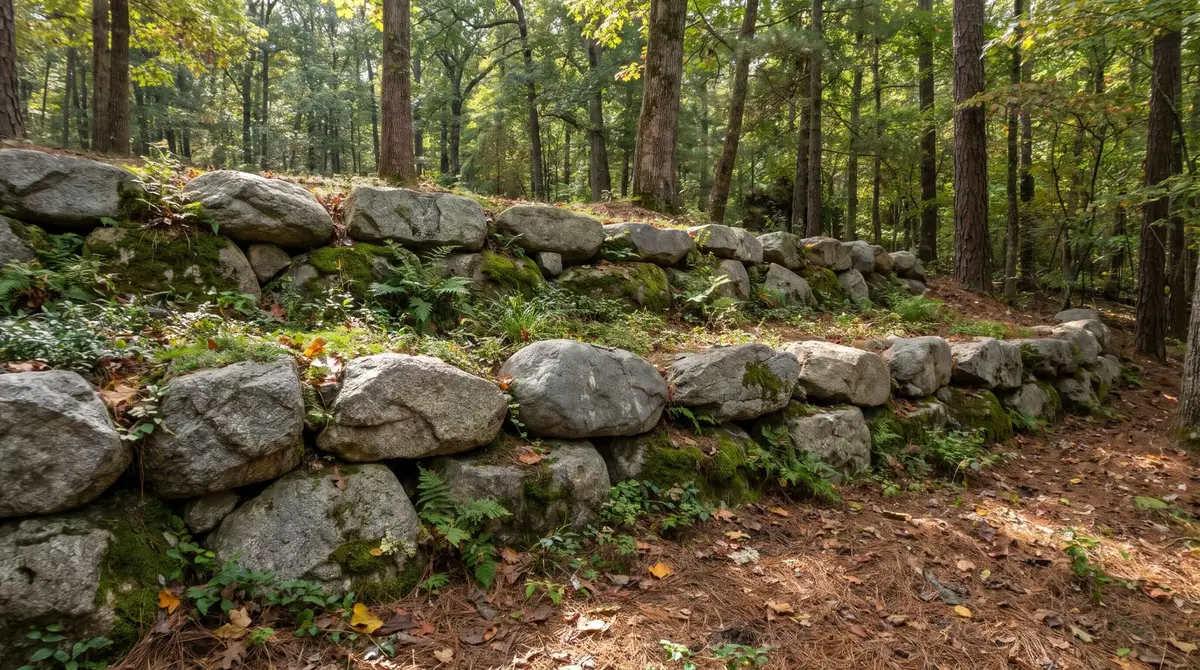
Natural boulders suit a wooded Forsyth County lot in a way no manufactured block quite does, particularly by the lake or along a driveway through the trees. A boulder wall is held up by the weight of the rock, so it needs a machine, a skilled operator and room to work. HomeGuide prices them at $25 to $50 a square foot, and says they're typically under 4 feet tall.
Call (470) 281-3568Rather not call? Send the detailsCalls are answered weekdays, 9 to 6. After hours, leave your name, address and what's going on, and you'll get a call back first thing the next business day.
How is a boulder wall different from a stacked stone wall?
| Type | What it is | Rough cost a square foot (HomeGuide) |
|---|---|---|
| Boulder | Large rocks set by machine | $25 to $50 |
| Natural stone | Smaller stone, dry-stacked or set in mortar | $20 to $95 |
| Gabion | Wire baskets filled with rock | $10 to $40 |
Dry-stacked stone relies on hand-fitting, which is slower and shows the mason's skill. Mortared stone has to deal with water differently, since the mortar closes the gaps that would let it out. Gabion baskets are rough-looking and practical, and they drain freely. Around Lake Lanier, they fall under the Corps' shoreline rules like any other wall.
How is a boulder wall built?
- Plan the access: Boulders arrive on trucks and move by excavator. Tight gates, soft lawns and septic fields affect the route.
- Call before digging: Georgia 811 needs at least 3 business days' notice before machine digging. Boulder walls always involve machines.
- Set the base row: The biggest rocks go first, dug in below grade on firm ground, with their flattest sides down.
- Stack back into the hill: Each row sits behind the one below. Rocks touch in at least a few places and shouldn't rock.
- Fill behind it: Gravel behind the rocks lets water out, with fabric between the gravel and soil so the clay doesn't wash through the gaps.
- Plant the gaps: Soil pockets and groundcover soften the look and help hold the top of the slope.
How tall can a boulder wall go?
HomeGuide says boulder walls are typically under 4 feet. Taller ones get built, but rock size and placement have to go up with height, and the design matters more. The state residential code calls for accepted engineering practice on a wall holding back more than 48 inches of unbalanced fill. In Forsyth County, over 6 feet from the bottom of the footing, a permit and engineered design are required. See engineered walls and permits.
Where a slope is too tall for one wall, two lower walls with a planted step between them often look better. Forsyth's code treats terraces as separate walls only if the gap between them is greater than the height of the tallest section.
What does red clay mean for a boulder wall?
Boulders let water through their gaps, which helps, but those same gaps can let soil out. Red clay is the common subsoil across much of Forsyth County, and the New Georgia Encyclopedia calls the Piedmont's saprolite highly erodible once it loses its cover. So if you see fine red soil washing out between the rocks after a storm, the fabric or gravel behind the wall needs attention.
How much does a boulder wall cost in Cumming?
HomeGuide's 2026 stone guide lists boulder walls at $25 to $50 a square foot. On a wall 50 feet long and 3 feet tall, 150 square feet, that's about $3,750 to $7,500. Natural stone runs much wider, $20 to $95 in HomeGuide's table and $20 to $90 in LawnStarter's, mostly depending on the stone and the handwork.
How far the rock travels and how close a machine can get matter a lot here. A front-yard wall by the driveway can be far cheaper than a backyard wall reached through a narrow side yard. Angi notes that labor can rise by 50% or more on a sloped lot.
Common questions
How long does a boulder wall last?
HomeGuide lists stone walls at 50 to 200 years and LawnStarter at 40 to 100. A boulder wall can shift a little without failing, and a loose rock can be reset.
Is a boulder wall cheaper than block?
Often about the same, or a bit more. By HomeGuide's figures, block is $15 to $40 a square foot and boulders are $25 to $50. The trucking and machine access can swing it either way.
Can I use rocks from my own lot?
Sometimes. Rock dug up during site work may save trucking, if it's big and sound enough. Ask a contractor to look before counting on it.
Do boulder walls need drainage?
They drain better than solid walls, but gravel behind the rocks and a way out at the bottom still help, especially against clay.
Sources: HomeGuide, Stone retaining wall cost (2026) (source); HomeGuide, Retaining wall cost (2026) (source); LawnStarter, How much does a retaining wall cost in 2026? (source); Angi, How much does it cost to build a retaining wall? (updated September 2026) (source); Georgia 811, The 811 process (source); International Residential Code 2024, R404.4 Retaining walls (source); Forsyth County, Fence and retaining wall permit packet (revised January 2025) (source); Forsyth County Unified Development Code, Chapter 16 (retaining walls in setbacks and terraces; third-party copy) (source); New Georgia Encyclopedia, Piedmont geographic region (source); USDA NRCS, Official soil series description: Madison (source); US Army Corps of Engineers, Lake Sidney Lanier Shoreline Management Plan (2004) (source).
Last reviewed November 5, 2026.
Rather not call? Send the details
A local retaining wall pro will call you back.