Engineered retaining walls and permits in Forsyth County
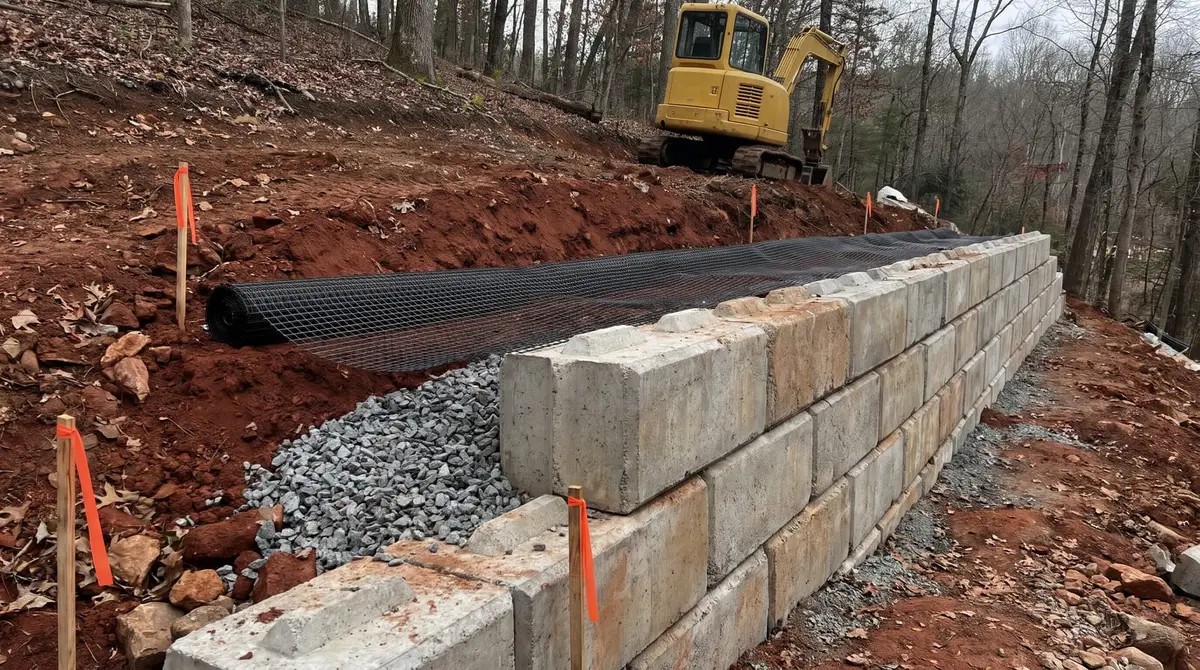
Forsyth County requires a permit and an engineered design for a retaining wall over 6 feet tall, measured from the bottom of the footing, not from the ground you can see. Inside Cumming, the city has its own permit for retaining walls. And the residential code Georgia uses calls for accepted engineering practice above 48 inches of unbalanced fill. A wall can trigger more than one of those, so it pays to sort this out before pricing the job.
Call (470) 281-3568Rather not call? Send the detailsCalls are answered weekdays, 9 to 6. After hours, leave your name, address and what's going on, and you'll get a call back first thing the next business day.
When does a wall need a permit in Forsyth County?
| Where or what | The rule | Who it comes from |
|---|---|---|
| Unincorporated Forsyth County | Over 6 feet from the bottom of the footing: permit and engineered design | County permit packet |
| City of Cumming | Separate fence and retaining wall permit, with site plan and inspections | City application |
| Georgia residential code | Over 48 inches of unbalanced fill: accepted engineering practice | IRC 2024, R404.4 |
| Near a stream or lake | 50-foot buffer plus a 25-foot setback | County and city codes |
| Digging with machines | Georgia 811 request 3 business days ahead | Georgia law |
The county and the code measure different things, and the county's pages don't square the two. A wall can be under the county's 6-foot permit line and still be over 48 inches of soil. So don't read the 6-foot rule to mean a shorter wall never needs an engineer. Taller or loaded walls deserve one regardless.
Many online guides mention a 4-foot permit line. That's a general rule of thumb from elsewhere, not the Forsyth County rule.
Why is the 6 feet measured from the footing?
Because the county measures the whole wall, including what's buried. A wall that shows 5 feet above the ground with a footing 18 inches below it counts as 6-1/2 feet. Under county rules, that one needs a permit even though you'd never think so from looking at it.
The Forsyth County Department of Engineering approves these walls before the building permit is issued. Owners can pull the permit themselves, and on a septic lot, Environmental Health has to approve first. The packet also says checking setbacks is the owner's responsibility.
What does an engineer do for a retaining wall?
- Look at the site and load: Height, what sits above (a driveway, pool, house or slope), and what's below.
- Work out the soil: Often a boring or soil test. The red clay here can behave very differently wet than dry.
- Design the wall: Base, drainage, and geogrid or steel. The code calls for a 1.5 safety factor against sliding and overturning.
- Stamp the plans: The county checks these drawings. Allan Block recommends a global stability analysis for walls that are terraced or especially tall.
- Check the build: Ask whether the engineer will inspect the base and grid, since the important parts get buried.
Do two short walls avoid the rule?
Not by themselves. Forsyth's code treats terraced walls as separate sections only when they are separated by a distance greater than the height of the tallest section. Two 4-foot walls 3 feet apart wouldn't count as separate under that rule. Upper walls also press on lower ones, and Allan Block recommends a stability analysis for terraces.
How much does an engineered retaining wall cost in Cumming?
The engineer: Angi says $350 to $750, and HomeGuide says $500 to $2,000 or more, depending on how complex the wall is. The permit: general guides put it at $50 to $450. In Cumming, the city form sets $0.06 a square foot plus a $50 review fee. Forsyth County's published fee schedule has no separate wall line, so ask when you apply.
The wall: HomeGuide's project range is $35 to $65 a square foot, with anchored walls at $50 to $150. On a tall wall, geogrid, extra excavation and special equipment drive the cost, so get the stamped plan first and have every contractor price the same design.
Common questions
Do I need a permit for a 4-foot wall in Forsyth County?
By the county's table, 6 feet or less needs no permit in the unincorporated county, but the height is measured from the bottom of the footing and the state code has its 48-inch rule. Inside Cumming, a retaining wall has its own city permit. Call first if the wall is near that height.
Can a homeowner get the permit?
Yes. The county's packet lists the documents needed when the owner applies. Many people still let the contractor handle it. Check who's responsible in the contract.
Can a retaining wall go in a setback?
The county's development code allows retaining walls in setbacks at any height, with some lot types treated differently. Buffers and easements are separate matters, and a survey can settle most questions.
What happens if a wall was built without a permit?
It can come up when you sell or if the county gets a complaint. Ask the county how to resolve it, as the fix depends on the wall.
Sources: Forsyth County, Fence and retaining wall permit packet (revised January 2025) (source); Forsyth County, Do I need a permit? (source); Forsyth County Unified Development Code, Chapter 16 (retaining walls in setbacks and terraces; third-party copy) (source); Forsyth County Unified Development Code, Chapter 18 (stream buffers; third-party copy) (source); City of Cumming, Fence and retaining wall permit application (2026) (source); City of Cumming Code, Chapter 11, Sec. 113-451: stream buffers (third-party copy) (source); International Residential Code 2024, R404.4 Retaining walls (source); Georgia Department of Community Affairs, State minimum standard codes (source); Georgia 811, The 811 process (source); Allan Block, Best practices for segmental retaining walls (source); HomeGuide, Retaining wall cost (2026) (source); Angi, How much does it cost to build a retaining wall? (updated September 2026) (source).
Last reviewed November 5, 2026.
Rather not call? Send the details
A local retaining wall pro will call you back.